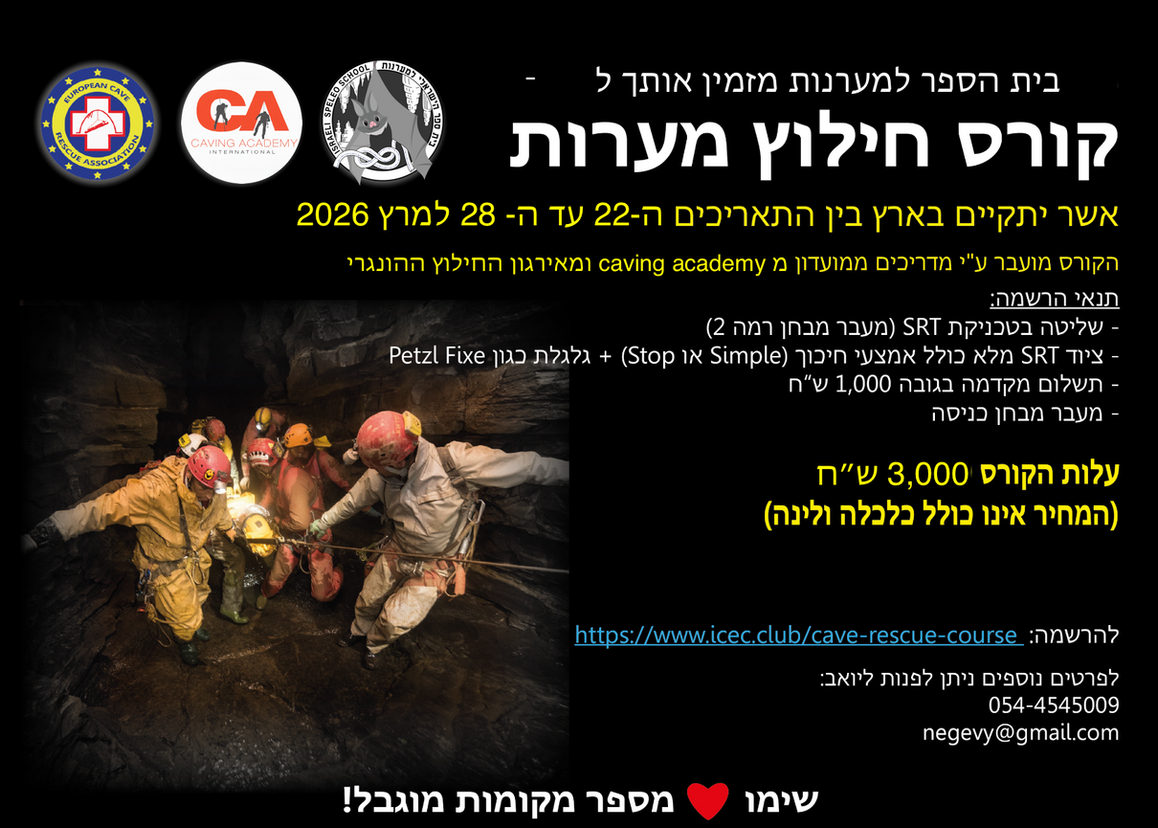
Cave rescue course (7 days)
The course is taught in Israel by instructors from the Caving Academy club and the Hungarian cave rescue organization. It is recognized by the European Cave Rescue Association (ECRA).
- Dates
- 21-27 March 2027
- Course price
- 3,000 ILS
- Down payment
- 1,000 ILS
The price does not include accommodation and meals. The number of places is limited!
Registration requirements
- Mastery of SRT technique (passing a Level 2 test)
- Full SRT kit including a friction device (Stop or Simple) + a Petzl Fixe pulley
- A down payment of 1,000 ILS
- Passing an entry test
Registration depends on a down payment of 1,000 ILS.
Not sure yet?
Leave your email address and we will keep in touch.
Course syllabus
| No. | Content | Theory | Practice |
|---|---|---|---|
| 1 | SRT – useful knots, anchoring methods, station-transfer techniques, etc. – review and refresher | Yes | No |
| 2 | Useful equipment for cave rescue (ropes, rope marking, knots, carabiners, pulleys, climbing aids, friction devices, etc.) | Yes | No |
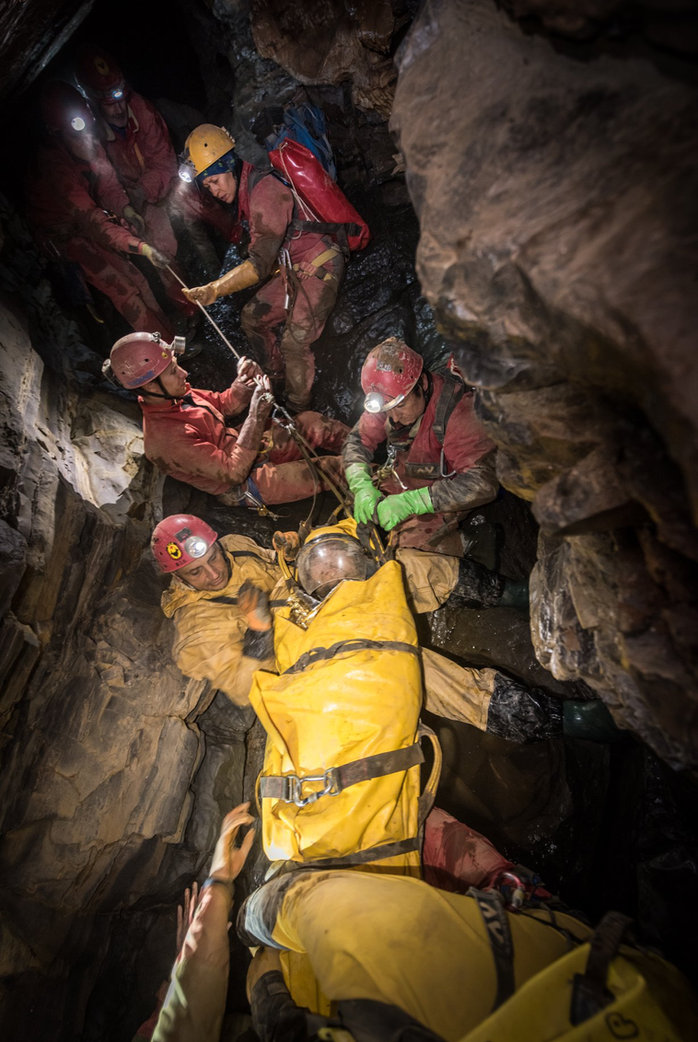
| 3 | Stretcher – the structure of a rescue stretcher suited to work in caves, how to attach the stretcher to the rope, attachment in a horizontal or vertical position, the equipment needed to move between positions, attaching and fixing the casualty to the stretcher, etc. | Yes | Yes |
| 4 | Distributing weight between three anchors – principles for building reliable, non-hanging anchor points and how to distribute weight correctly. | Yes | Yes |
| 5 | Stretcher haul system – getting to know the different useful haul systems, the efficiency of the different systems, the advantages and disadvantages of each, etc. | Yes | Yes |
| 6 | Changing the direction of the stretcher from lowering to hauling and back. | Yes | Yes |
| 7 | Passing a knot with the stretcher while ascending and descending. | No | Yes |
| 8 | Stretcher belay – in which cases, and with what equipment and methods, to belay. | Yes | Yes |
| 9 | Escorting the stretcher – escort methods: attached / independent escort. | Yes | Yes |
| 10 | Counterweight – the advantages of practicing it, the communication between the haulers, and the different roles in practice. | Yes | Yes |
| 11 | Counterweight + haul system: transition at a step or cliff edge. | No | Yes |
| 12 | Moving the stretcher on a horizontal rope (Omega) – suitable knots, how to secure the stretcher, lowering the stretcher from the rope, raising the stretcher onto the rope with the help of a haul system or counterweight. | Yes | Yes |
| 13 | Changing the direction of the rope pull – using pulleys on anchors, 'human' pulleys for changing direction. | Yes | Yes |
| 14 | Reverse pulley – advantages and disadvantages, required equipment, loaded weights. | Yes | Yes |
| 15 | Traverses – how to move and secure the stretcher over a traverse. | Yes | Yes |
| 16 | Moving the stretcher – in open spaces, galleries, meanders, narrow passages, etc. | Yes | Yes |
| 17 | Organising and managing a rescue operation – roles, communication, rescue groups, etc. | Yes | No |
| 18 | Types of stretchers used in different countries. | Yes | No |
| 19 | A historical overview of cave rescues, ECRA (the European cave rescue organization), cave rescue films. | Yes | No |
For more details, contact Yoav: 054-4545009, negevy@gmail.com